
The Avenue of the Baobabs, a pair of trees that grew into each other, and a rescue centre where orphaned lemurs are taught to be lemurs again.
The price shown is for a party of 6. Rates change with group size — tell us how many of you are travelling and we will quote your exact number, usually the same day.
No payment now · A real person replies within 24h · 30% deposit only once you approve the plan
Timed to your ship's call. We meet you at the gangway and have you back on board well before departure.
The Avenue is at its best in late afternoon light. On this call the ship sails at 19:00, so we see it in the afternoon rather than at sunset — the sunset photograph needs an overnight, which this itinerary does not pretend to offer.
Morondava is a small west-coast town with one road worth travelling, and it is lined with baobabs eight centuries old. You start at Kimony, a private reserve on the coast that takes in injured and orphaned lemurs — semi-open forest, animals that come to you rather than hide, and a team who explain what rehabilitation actually involves and let you help with the youngest. Then the Baobab Amoureux, two trunks that have grown around each other over centuries, and finally the Avenue itself.
What you get for the hours you have ashore — no filler stops.
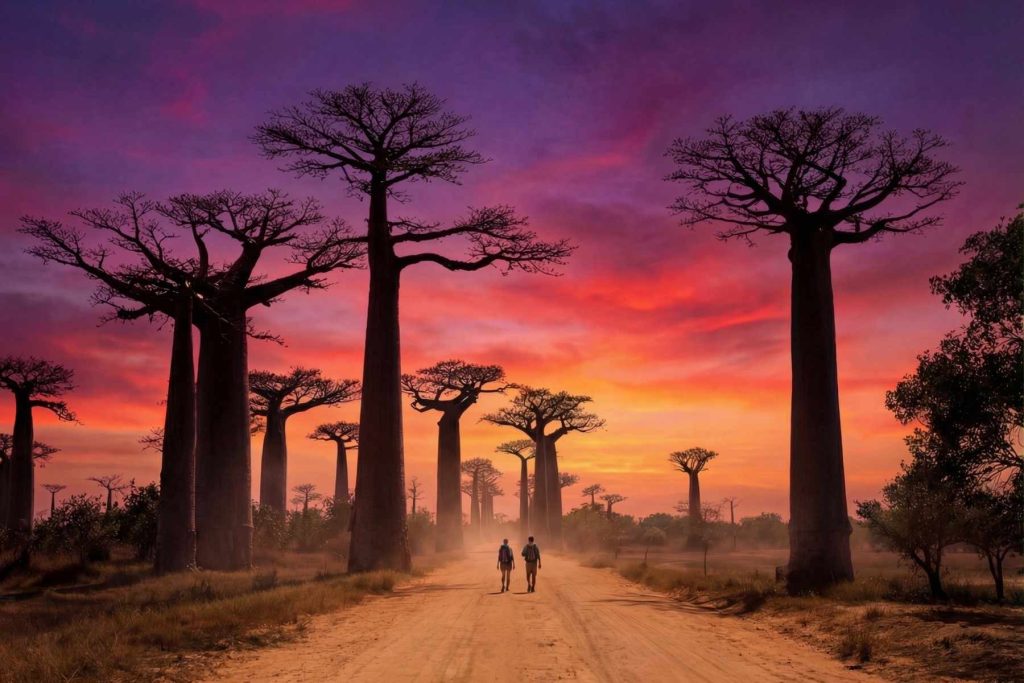
Several dozen trees, up to 30 metres tall and eight centuries old, standing along a red dirt road. The image that brought you to Madagascar.
Two baobabs whose trunks have grown around each other and kept going up. Local story says they are lovers; the botany is stranger.
A working rescue centre for injured and orphaned lemurs, in a private reserve on the coast. Not a petting zoo — a rehabilitation project.
The team let visitors help with infant lemur care under supervision. It is the part people remember.
The animals move freely through it, which is why sightings are close and natural rather than staged.
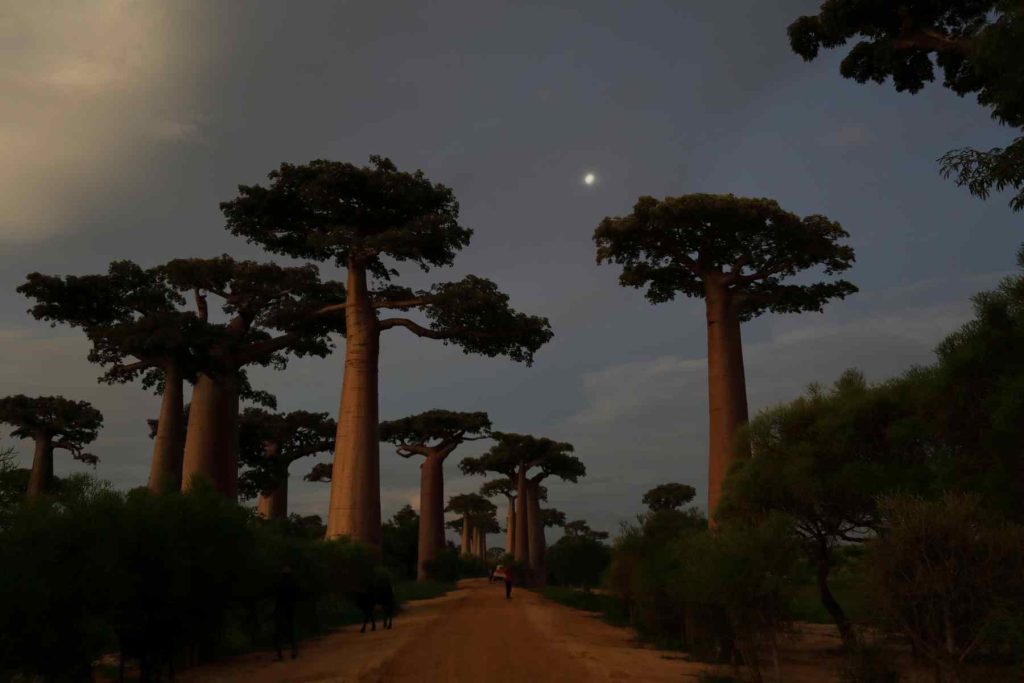
Flat, dry, and the light on the laterite road at four in the afternoon is the reason photographers come here.
In order, from the moment you walk down the gangway to the moment you walk back up it.
Your guide meets you where the tender or the ship's boats land and drives the short distance south to Kimony, a private reserve on the Morondava coast. This is a rescue and rehabilitation centre for injured and orphaned lemurs, not a display collection: the animals live in semi-open forest and move as they choose, which is why they come close rather than hiding. A keeper walks you through the work — infant care, pre-release training, what happens to animals that cannot go back. Under supervision you can help with the youngest, which is the part most visitors remember.
North out of town to the Baobab Amoureux — the lovers' baobab. Two trees that grew into each other: the trunks have wound together and the branches interlock above, so from a distance it reads as one tree embracing itself. Several hundred years old, and one of the most photographed pairings on the island. The local story is about two lovers; the botanical explanation is stranger and your guide will give you both.
The Avenue itself — several dozen Adansonia grandidieri standing along a stretch of red dirt road, 30 metres tall and up to eight centuries old. They are not a plantation and nobody planted them in a line; this is what is left of a forest that was cleared around them. You walk the road, and the guide explains why these particular trees survived when the rest did not. Afternoon light here is good; the famous sunset shot needs you to stay overnight, which this call does not allow.
Return to the coast and the ship, aiming for 16:00 against a 19:00 sailing. The extra three hours are not slack — Morondava's roads are sand tracks in places and the ship's boats run to their own schedule. If your vessel is at anchor and tendering, allow for the swell on the way out.
One price, quoted per person, with the awkward extras already in it. We publish what is not included too, so there are no surprises on the ground.
per person · based on 6 travellers · lunch included
The final figure depends on how many of you travel, your dates and the hotel category. Tell us your dates and we send one clear number — not a range.
Get the exact price for my datesReply within 24 hours, Monday to Saturday. Domestic flights quoted at the fare available on the day.
Madagascar is not a country where things fix themselves on the day. When the road is washed out or a flight moves, who you booked with decides how fast it gets solved.
| Booking direct with us | Booking through a reseller | |
|---|---|---|
| Who runs the tour | The operator, in Antananarivo | An agency that resells to a local operator |
| Price | Direct rate, no commission layer | Usually a commission added on top |
| If a flight or road changes | We rearrange it ourselves, same day | Message relayed to a third party |
| Vehicle and guide | Our own fleet, our own guides | Whichever supplier is available |
| Who answers your email | The person who will brief your guide | A call centre or sales desk |

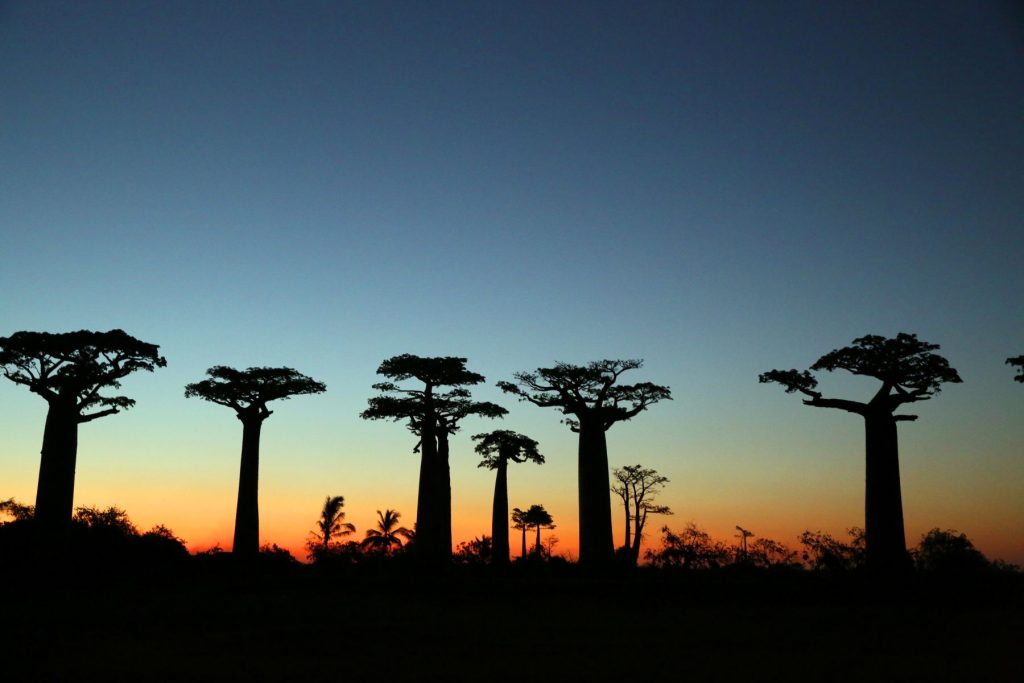
No, and we would rather say so now. The ship sails at 19:00 and sunset on this coast is around 18:00 — it does not work with a safe return. You get the Avenue in the afternoon, which is still very good light. The classic sunset photograph needs a night in Morondava, which is a different trip.
Yes. The Avenue is a public road and you walk along it freely with your guide. Farming continues either side, so stay on the road and ask before photographing people working.
Yes, and it is usually the highlight for them. The animals come close but the interaction is supervised, and the team are clear about what visitors can and cannot do. Tell us ages when booking.
Morondava is often an anchorage rather than a berth, and the swell can make the boat ride uncomfortable on the way back. If you are prone to seasickness, take a tablet before you leave the ship. We build the return timing with that in mind.
Six travellers sharing one vehicle, which is the rate shown. Smaller groups pay more each, larger groups less, because vehicle, guide and fuel are shared. Tell us your number and we quote exactly.
Most nationalities get a 15-day visa on arrival for USD 35 or EUR 30. Arriving by sea the formalities can differ from an airport arrival — confirm the current rule for your nationality with us when you enquire.
You are writing to the office in Antananarivo, not a call centre. A named person reads it, checks flight availability and hotel space for your dates, and comes back with a written plan you can approve or change.
Two minutes. The more you tell us, the more useful the first reply will be.